
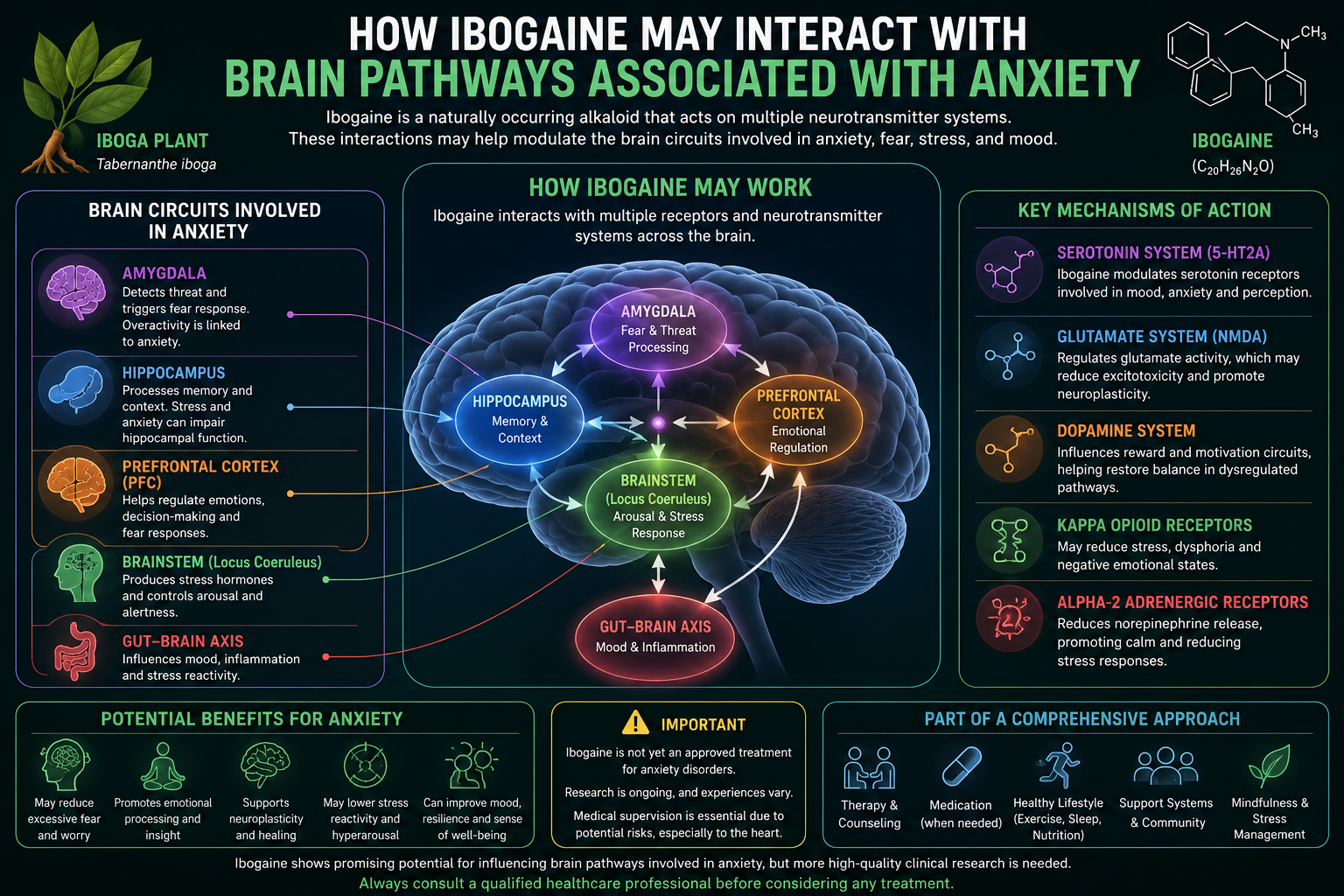
Anxiety disorders can affect how a person thinks, feels, behaves, sleeps, works, and interacts with other people. Occasional anxiety is a normal response to stress, but an anxiety disorder can persist, become difficult to control, and interfere significantly with everyday life. Fortunately, effective treatments and support options exist, and many people can learn to manage their symptoms and regain control of their lives.
Interest in iboga and ibogaine has also grown among people looking for alternative approaches to mental and emotional health. Researchers have investigated ibogaine’s effects on several neurological systems, and some early research has explored its relationship with anxiety, depression, trauma, and substance-use disorders. However, current evidence does not establish ibogaine as a proven treatment for anxiety disorders, and its potentially serious cardiovascular effects require substantial caution.
Anxiety disorders describe a group of mental health conditions involving excessive fear, worry, nervousness, or apprehension.
Everyone experiences anxiety from time to time. For example, an upcoming examination, job interview, financial difficulty, or major life change can naturally cause nervousness.
The difference becomes important when anxiety persists even when there is no immediate threat or when the symptoms interfere with normal life.
Common anxiety disorders include:
Different disorders can produce different symptoms, but they often involve excessive fear, persistent worry, avoidance, physical tension, or heightened alertness.
Anxiety can affect both the mind and body.
A person may experience:
Anxiety can also produce:
Some people experience panic attacks, which can involve sudden intense fear, rapid heartbeat, chest discomfort, shortness of breath, trembling, or a feeling of losing control.
Because some anxiety symptoms resemble symptoms of physical illnesses, people with new, severe, or unexplained symptoms should seek appropriate medical evaluation.
Anxiety rarely develops from one single cause.
Several factors can contribute, including genetics, brain chemistry, personality, stressful life experiences, trauma, chronic stress, sleep disruption, and certain medical or substance-related factors.
For some individuals, anxiety begins after a particularly stressful event. For others, symptoms develop gradually.
Substances such as stimulants, excessive caffeine, alcohol, and certain medications can also worsen anxiety in susceptible individuals.
Understanding the underlying factors can help healthcare professionals develop an appropriate treatment plan.
The brain constantly evaluates whether situations are safe or threatening.
An important structure involved in fear processing is the amygdala. Other brain networks help regulate attention, memory, emotional responses, and decision-making.
When someone experiences chronic anxiety, these systems can become excessively focused on potential threats.
The person may begin interpreting ordinary situations as dangerous. Over time, avoidance can reinforce the anxiety because the individual never gets the opportunity to learn that the feared situation may actually be manageable.
This cycle helps explain why effective anxiety treatment often focuses on changing both thoughts and behaviors.
Anxiety disorders are treatable. The most appropriate approach depends on the person’s symptoms, diagnosis, medical history, and individual circumstances.
Psychotherapy represents one of the most established approaches to anxiety treatment.
Cognitive behavioral therapy (CBT) can help individuals identify unhelpful thought patterns and develop healthier responses to anxiety.
For example, someone with social anxiety may automatically assume that everyone will judge them negatively. CBT can help them examine that belief and gradually develop more realistic interpretations.
Avoiding feared situations can temporarily reduce anxiety but may strengthen fear over time.
Exposure-based therapy carefully and gradually introduces a person to feared situations while teaching them healthier ways to manage their response.
A qualified therapist should guide this process, particularly when anxiety symptoms are severe.
Healthcare professionals may recommend medication for some people with anxiety disorders.
Depending on the diagnosis, treatment may involve medications such as certain antidepressants or other prescription medicines.
Medication decisions should always involve a qualified healthcare professional because benefits, side effects, interactions, and individual medical factors need to be considered.
Healthy habits can complement professional treatment.
Helpful strategies may include:
These approaches may not replace professional treatment, but they can support overall mental well-being.
Iboga is a plant native to parts of Central and West Africa. Traditional communities have used iboga preparations in spiritual and ceremonial settings.
Ibogaine is a psychoactive alkaloid found in iboga.
Researchers became interested in ibogaine because it interacts with multiple neurological systems. Scientists have investigated its effects on serotonin, dopamine, glutamate, opioid, and nicotinic receptor systems.
This complex pharmacology has led researchers to explore whether ibogaine could influence addiction, mood, trauma-related symptoms, and other psychological processes.
However, researchers still need considerably more evidence before they can determine whether ibogaine has a safe and effective therapeutic role for anxiety disorders.
Some people who undergo ibogaine experiences report changes in mood, emotional processing, or psychological perspective. These reports have contributed to scientific interest in the substance.
Research involving ibogaine has particularly focused on substance-use disorders. Some studies have reported improvements in psychological measures alongside reductions in substance use, but these findings do not prove that ibogaine directly treats anxiety.
A major limitation involves the small number of controlled clinical trials. Much of the available evidence comes from observational research, case reports, retrospective studies, or people receiving ibogaine for substance-use problems.
Therefore, it would be misleading to describe ibogaine as an established treatment for generalized anxiety disorder, panic disorder, social anxiety disorder, or other anxiety conditions. To learn and understand more click here
Ibogaine’s effects involve multiple neurotransmitter systems, which makes it scientifically interesting.
Researchers have proposed that its complex pharmacology could influence neural circuits associated with reward, emotional regulation, stress, and behavioral patterns.
Some researchers also study noribogaine, a metabolite produced when the body processes ibogaine. Noribogaine has its own pharmacological effects and may contribute to some of the longer-lasting effects associated with ibogaine.
However, scientific hypotheses should not be confused with established clinical benefits.
The fact that ibogaine affects several neurological pathways does not prove that it can safely treat anxiety.
People considering ibogaine for anxiety should approach the subject carefully.
Ibogaine is interesting from a research perspective, and it currently doesnt lacks sufficient evidence to recommend it as a standard treatment for anxiety disorders.
Someone experiencing anxiety should first receive an appropriate assessment. A healthcare professional can determine whether the symptoms represent an anxiety disorder or another condition.
This distinction matters because anxiety can sometimes occur alongside depression, PTSD, substance-use disorders, medication effects, thyroid problems, sleep disorders, or other medical conditions.
Treating the underlying cause can significantly change the recovery strategy.
Safety represents one of the most important considerations when discussing ibogaine.
Research has associated ibogaine with QT-interval prolongation, potentially dangerous cardiac arrhythmias, bradycardia, seizures, neurological effects, and other adverse events. Fatal outcomes have also been reported.
People with certain heart conditions or those taking medications that affect cardiac rhythm may face particularly serious risks.
Ibogaine can also interact with other substances and medications.
For these reasons, people should not self-administer ibogaine or attempt to calculate their own dose. Anyone considering an ibogaine-related intervention should discuss the risks with qualified healthcare professionals and undergo appropriate medical and cardiac screening.
Anxiety recovery involves more than eliminating symptoms temporarily.
A strong treatment plan should help someone understand what triggers anxiety, develop coping skills, improve emotional regulation, and gradually return to activities that anxiety may have restricted.
Professional support can also help identify co-occurring problems.
For example, someone might use alcohol or another substance to cope with anxiety. In that situation, treating only the anxiety may not address the entire problem.
An integrated approach can provide better opportunities for long-term improvement.
A practical recovery plan can include several components:
Identify triggers: Keep track of situations, thoughts, environments, or habits that increase anxiety.
Develop coping skills: Breathing exercises, grounding techniques, mindfulness, and relaxation strategies can help manage acute symptoms.
Challenge anxious thoughts: Learn to question catastrophic assumptions rather than automatically accepting them as facts.
Improve physical health: Sleep, exercise, nutrition, and reduced stimulant consumption can support emotional stability.
Build social support: Trusted friends, family members, counselors, and support groups can reduce isolation.
Follow professional treatment: Consistency matters when participating in therapy or taking prescribed medication.
Plan for setbacks: Anxiety can fluctuate. A difficult day does not mean that treatment has failed.
Yes, potentially—but research is still developing.
Ibogaine has attracted interest as a potential tool for supporting people experiencing anxiety because of its complex effects on several neurological systems involved in mood, stress, emotional processing, and brain function.
Some individuals report changes in emotional awareness, mood, and psychological perspective following ibogaine experiences. These observations have encouraged researchers to investigate whether ibogaine could eventually have a therapeutic role in anxiety-related conditions.
Ibogaine may therefore become a valuable area of research for anxiety treatment, particularly when researchers combine it with appropriate psychological support and professional monitoring. However, larger, well-controlled clinical trials are still needed to determine how effective it is, which people may benefit, and how professionals can use it safely.
A responsible approach should combine ibogaine research with appropriate medical assessment, psychological support, professional monitoring, and an individualized recovery plan. Ibogaine should complement—replace established medical and psychological care .
Anxiety disorders can feel overwhelming, but they do not have to define someone’s future. With appropriate assessment, therapy, medical support, healthy lifestyle changes, and a strong support network, many people learn to manage anxiety and improve their quality of life.
Iboga and ibogaine remain subjects of scientific investigation because of their complex effects on the brain. While these substances may offer interesting research opportunities, current evidence establish ibogaine as a proven treatment for anxiety disorders, and its potentially serious medical importance must be taken seriously.
For educational information about iboga, ibogaine, and their emerging role in mental-health and addiction research, visit TAIBOGA.COM or CONTACT THE CEO OF TAIBOGA ON WHATSAPP DIRECTLY FOR YOUR TREATMENT at +237 653 823 790.
